

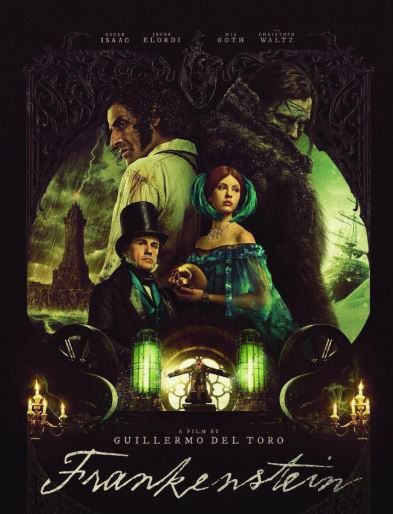
Guillermo Del Toro’s film adaptation of Frankenstein released to Netflix on November 7 is a striking reimagining of Mary Shelley’s 19th century gothic novel, blending mesmerizing visuals with a refreshing new take on the tragic tale of the monster.
From a visual standpoint alone this film was stunning. Each shot captured the gothic, brooding atmosphere of this era, fully immersing viewers within this haunting narrative. The wardrobe also heightens the world as vibrant jeweled-tones and extravagant silhouettes provide an intensity and stark contrast to the bleak scenery.
What truly elevates this film, however, is the exceptional cast. Jacob Elordi brings Frankenstein’s monster to life with an unexpected yet welcome intensity. Despite his character being almost completely nonverbal in the first half of the film he manages to convey the creature’s innocence and complexity through poignant facial expressions alone, immediately drawing sympathy from the audience. Oscar Isaac also delivers a brilliant performance as Victor Frankenstein capturing the scientist’s witty arrogance and gradual descent into obsession as he pursues his dangerous promise of creating new life.
Of course, Mia Goth’s performances are no exception as she takes on two roles within the film; Victor’s late mother through flashbacks and Elizabeth Laventa his brother’s fiance in the present. Still considering her incredible range in the X trilogy, it would have been great to see her given more material to work with as her character felt underdeveloped at times.
In Del Toro’s adaptation there is no doubt that Victor is painted as the true villain of the story. He dedicates a great amount of time and effort to bring his creation to life only to verbally abuse and taunt the poor creature for his limited understanding of the world. Instead of nourishing the creature’s mind he chooses to torment it for not fitting his unattainable standards. Ultimately abandoning his creation out of his own cowardice and pride. While Victor is depicted as an emotionally nuanced character, he can be summed up in simple terms: a deadbeat dad.
Elordi’s portrayal of the creature is truly exceptional, although maybe due mainly in part to the brilliance of the script, which manages to encompass the creature’s shifting emotions as he grapples with ideas of loneliness, love, rage, and, in the end, forgiveness. The creature’s relationship with Elizabeth is another interesting and original aspect, as in past adaptations, their interactions are minimal and even hostile. However, in this version, Elizabeth is the first to show him genuine kindness and a glimpse of humanity, shaping many of his later actions in the film.
While many themes and characters in the movie had to be dulled down to size in order to fit within the standard runtime of a Netflix movie, this film still manages to deliver a resonating message. A particularly impactful change this movie made from the original novel was the final scene. In the book, there is no mutual forgiveness between Victor and the creature. However, in Del Toro’s rendition, he ends the movie with an emotionally bittersweet scene of reconciliation between the two. Ultimately, Frankenstein 2025 provides a unique yet familiar take on humanity; it is not the conventional monster who is the villain but often mankind.