

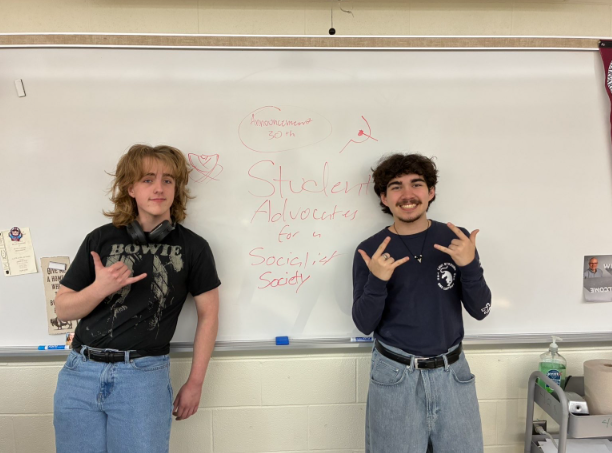
Whether it be television, videos circulating on social media, protests going on around the country or even just word of mouth, politics has never been as accessible as it is today. Despite this, teens have found themselves in a peculiar situation regarding the ever-changing landscape of American politics. They feel they are too young to have a confident opinion yet too mature to be oblivious to the current state of affairs in our country. Junior Rhyler Betz, alongside English teacher and club sponsor Jack Hutchens, seeks to break the youth’s silence and normalize political education through Plainfield East’s new club Student Advocates for Socialist Society (SASS).
“I saw a lot of bad things and things that needed to be solved, I saw the current solutions weren’t working, so I looked for an alternative,” said Betz. “Then I found socialism.”
The word “socialism” often sets off alarms in the heads of people who aren’t familiar with the concept as a whole. Even at a school like Plainfield East, which is located in a traditionally democrat-voting area, the ideology can still make some uneasy.
“It’s been culturally rooted in us that it’s kind of evil. We’ve been raised to know ‘socialism bad’, to not give it a second thought,” said Sotiris Rezkalla, senior.
SASS aims to present socialism in a new light, one that emphasizes helping the community and establishing equality. They want to completely redefine what the average student thinks constitutes socialism.
“A lot of people have a very spoon-fed definition of what socialism is,” said Betz. “They think many slanderous things about the ideology itself, when at its foundation it is democracy. We don’t just want democracy in that we can vote who becomes president, but democracy in choosing where we want to work and how we are impacted by our workplace and that is the core of socialism, more equality for those who have less, and fairness for the entire nation, not just for those who have more or less wealth.”
Having a club of this nature at a public school can be controversial for those who aren’t as open with their politics. Some students believe the ideas should be kept within the club in order to protect East as a safe space.
“As long as you keep your political views at bay or at least in the club and not just spread it around, because then there will be conflicts towards other kids,” said Mia Valeriano, senior. “The school won’t be a safe space anymore, it’s not a learning area, it’s more like a divided area now that you’re spreading your political views.”
There are also concerns around the school that high school students are too inexperienced to commit themselves to a group like this.
“I think we’re slightly too young. We haven’t fully developed and haven’t seen the world enough to know what our views are truly,” said Rezkalla.
Simultaneously, there is a belief that students should be learning about politics to prepare for the real world.
“But at the same time we should also start developing those opinions now sooner than later, we have to know what to start thinking now,” said Rezkalla.
Other students believe that SASS and other political clubs can help to get rid of that fear concerning politics in a public environment. Sophomore SASS member Max Wettergren, for instance, felt the group helped him become educated, not only on socialist issues, but the importance of politics.
“Politics are kind of taboo I feel, and having a club like this really kind of helps ease that pressure of this being something we shouldn’t talk about into something we should talk about, because if you don’t talk about it nothing is going to change,” said Wettergren.
When he initially entered the club, Wettergren was by no means a full-fledged socialist. He was simply curious about other perspectives on the political spectrum.
“When I joined I was a little on the fence about it, but after hearing and listening to what socialism was and hearing the other side talk, I guess I just got open-minded,” said Wettergren.
During their meetings, SASS discusses different problems in society that socialist policies could be applied to, not only in the United States but locally as well. Conversation is sparked the majority of the time by students rather than Hutchens.
“When they have their meetings I try to set off to the side, [Betz] is the guy who started it, he’s the leading voice and I try not to take over anything, I just help with explaining some ideas,” said Hutchens.
One suggestion Hutchens did make was each member bringing a non-perishable food item to each meeting in order to further their efforts in bettering the surrounding community. Good deeds such as this are one of the few things that bring a positive connotation to socialism.
“I’ve always seen it closely related to morals and having good morals, because I feel like a lot of what they’re saying a lot of people would agree on because most of their arguments are just having good morals,” said Charles Hidalgo, senior.
Hidalgo suggests that socialism scares people because they think of it as a radical, world-flipping movement, rather than an alternative economic structure.
“When people do see it, it’s presented in a way where it seems kind of questionable,” said Hidalgo. “What they’re trying to say and the message they’re trying to portray, that is a good thing because obviously they’re trying to help the economy and make everything more equal.’
With groups such as Turning Point USA and SASS on the rise at public schools, it’s easy for a sense of division to set in, but Betz suggests that such a wide range of ideas is actually a good thing.
“I would say that if a student is already getting into politics, then they are open to the other side,” said Betz. “While my club offers a look into the leftist point of view, clubs like Turning Point USA offer their perspective. Even though we disagree on a lot of things, as long as the discourse is happening, then a solution can be found.”

Rebecca A Scott • Feb 2, 2026 at 2:06 pm
Wow! How did I miss the new